Sunday Review - Nov 30, 2025


Sunday Message Review
Understanding God's Word: More Than Just Text on a Page
When we approach the Bible, many of us treat it like a religious textbook or a manual for Christian behavior. We flip through pages looking for instructions on what to do, searching for moral guidelines, or trying to decode prophetic mysteries. But what if we've been missing the point entirely?
What Does It Mean for the Word of God to Be Living and Active?
The Bible tells us in Hebrews 4:12-13 that
"the word of God is living and active, sharper than any two-edged sword, piercing to the division of soul and spirit, of joints and of marrow, and discerning the thoughts and intentions of the heart."
This isn't describing a static book sitting on your shelf - it's describing something dynamic and alive.
When God's Word comes to us through His Holy Spirit, it doesn't just give us information. It reveals what's happening in the deepest parts of our hearts. It exposes our true motivations and intentions, going far beyond surface-level behaviors to address the "why" behind what we do.
How Does the Holy Spirit Work Through Scripture?
Without the work of the Holy Spirit, the Bible becomes just another religious text - a system of beliefs that can trap us in legalism. But when the Spirit breathes life into these words, they become the firm foundation for our lives.
The Holy Spirit doesn't just help us understand doctrine or theology. He reveals Jesus to us through every page of Scripture. As Jesus promised in John 15:26,
"When the Helper comes, whom I will send to you from the Father, the Spirit of truth who proceeds from the Father, he will bear witness about me."
This means when we receive God's Word - the Holy Spirit is showing us what God is like and how we can know Him. We're not just learning about ancient history or moral principles; we're encountering the living God.
Three Ways God's Word Comes to Us:
- The Person of Christ ( Jesus the Word) - John 1:1-3, 14; John 6:63; Revelation 19:11-16
- The Spoken Word - Genesis 1:3, 15:1; Matthew 4:4; John 15:7
- The Written Word - Luke 24:25; Romans 15:4; 2 Timothy 3:16
Now, this is going to get a bit nerdy, but stick with me. When we typically see the English word "word" in our Bible, we simply assume it is talking about Bible text. From what we saw above, there are three distinct way God's Word is transmitted and just one of them is in written form. If we are to receive the whole word of God, we cannot minimize or trivialize any part. These three ways God speaks to us is seen in the Old and New Testament in the form of three distinct Greek words (Logos, Rhema, Graphe) used in the Bible text, while the Hebrew typically uses one (Davar) to help us see how God uses words when He communicates:
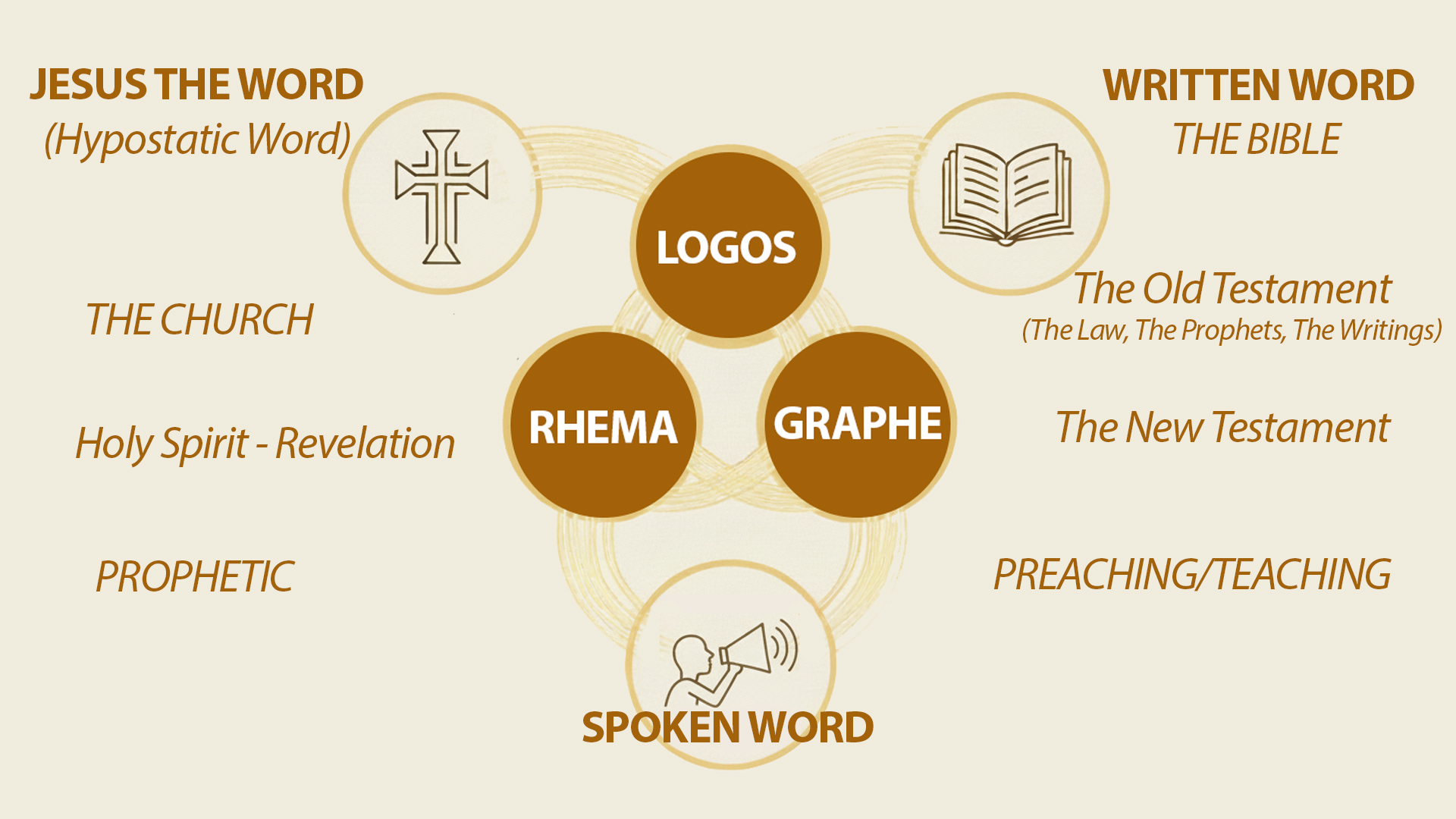
Let me use Jesus as the study subject to show why and how the Bible in these three form is regarded as the authoritative guide for the Christian :
Logos - the evidence, proof, explanation or description of a matter. Jesus as a person is the evidence and proof of God. He is the explanation and proof of who God is in visible form. Jesus doesn't just speak God's word; he IS God's word. When the church (The Body of Christ) walks in step with the Holy Spirit, we represent Jesus to the world and stand for Truth. The Bible shows us who Jesus was, what He did, and the way He lived.
Rhema - the speaking or vocalizing of a matter. This is the spoken word of God, the message that comes directly from Christ. When Jesus speaks - whether through Scripture or by His Spirit in our hearts - these words have creative, transformative power. When the word of Christ dwells in us, we are changed to be like Him. Scripture echoes and confirms the transformation we see in our lives.
Graphe - the writing or inscription of sacred text. This refers to the written Scriptures. These are the recorded testimonies of those who witnessed Jesus and received revelation from God, preserved for us to know Him. These writings confirm the identity and person of Jesus from ancient prophecy in the Old Testament and proceed to show us the way of Christ to follow as the church in the New Testament.
Why Was the Bible Written?
Here's a crucial distinction: the Bible wasn't written TO you, but it was written FOR you. Each book was originally addressed to specific people in specific situations - but God's intent was always that future generations would benefit from these revelations of God's character and ways. It was never just as informational or anecdotal sayings but as words of revelation and teaching by His Holy Spirit.
The apostle Peter, who was an eyewitness to Jesus' ministry, wrote: "We did not follow cleverly devised myths when we made known to you the power and coming of our Lord Jesus Christ, but we were eyewitnesses of his majesty" (2 Peter 1:16). These weren't made-up stories or philosophical musings - they were testimonies of people who encountered the living God.
What Should Our Response Be When God Speaks?
When God calls our name through His Word, our first response should be "Yes, Father" - not "Huh?" or "What?" or "I'm not convinced yet." This isn't about blind obedience to a book, but about recognizing that the God of the universe is speaking to us personally.
Think about it this way: when a loving parent calls their child's name, they expect a response. If there's no answer, the parent assumes something might be wrong. Similarly, when God speaks through His Word, He's looking for our hearts to respond with attention and willingness.
How Do We Avoid Making the Bible an Idol?
It's possible to revere the Bible as a book while missing the God who speaks through it. When we approach Scripture primarily looking for:
- Rules to follow
- Ammunition against others
- Hidden codes or prophecies about current events
- Scientific or historical details
We can miss its primary purpose: to know God and His plan for us in His kingdom.
The Bible isn't meant to be our morning devotional routine or a tool for judging others. It's meant to be an encounter with the living God who wants to reveal His heart to us.
What Does It Mean to Be the Living Word Today?
Jesus, who is the Word of God, now lives in and through His church by the Holy Spirit. We're called to be His ambassadors, representing Him to the world. This doesn't mean we become Jesus individually, but collectively as the church, we manifest His presence and character.
When the church operates in unity under the Holy Spirit's guidance, people should be able to see Jesus through us. We become the living expression of God's Word in our generation.
Life Application
This week, change how you approach God's Word. Instead of reading the Bible looking for what you should do, read it asking "Who are You, God?" and "What do You want to show me about Yourself?"
When you open Scripture, expect God to speak personally to you. Listen for His voice with the same attentiveness you'd give to a loving parent calling your name. Respond with "Yes, Father" before you even know what He's asking.
Questions for Reflection:
- When I read the Bible, am I looking for rules to follow or seeking to know God's heart?
- How quickly do I respond when I sense God speaking to me through His Word?
- Am I treating Scripture as a living encounter with God or just as religious text?
- In what ways might I be using the Bible for purposes other than knowing and following Jesus?